
Lyon County Court Records After a Jail Arrest
After a Lyon County arrest, the jail record and the court record separate quickly. The Lyon County Jail roster records custody details such as booking date and time, arresting agency, listed charge text, and custody or bail status. The court record begins when a charging document is filed in Minnesota district court. In Lyon County, that usually means the Lyon County Attorney has reviewed the arrest information and filed a complaint or made another charging decision.
Minnesota counties use a County Attorney rather than a District Attorney. The official Lyon County Attorney page identifies County Attorney Abby Wikelius at 607 West Main Street, Marshall, MN 56258, phone (507) 537-6755. The office prosecutes adult and juvenile crimes and may amend, reduce, add, or dismiss charges as the case develops. The jail does not decide the final filed charges.
Use Lyon County jail inmate records for the roster and current custody side of the arrest. Use Lyon County jail mugshots for the booking-photo question, including the important local finding that the inspected current roster did not show mugshots. Court records after an arrest belong to the court path: filed charges, case events, hearing dates, bond orders, warrants in a case, dispositions, and certified-copy requests.
How to Find Court Records After an Arrest in Lyon County
The main online court portal is Minnesota Court Records Online, commonly called MCRO. MCRO covers Minnesota district courts, including Lyon County District Court in the Fifth Judicial District. It includes search paths for cases, documents, hearings, judgments, registers of actions, and public documents available under remote-access rules. MCRO is not the certified court record. Certified copies must come from local court administration.
The pending criminal name-search limit is central for post-arrest research. MCRO's FAQ states that a pending criminal case cannot be searched by defendant name until there is a conviction. For a pending criminal case, use a case number, citation number, attorney name, or attorney bar number. That means a person can appear on the Lyon County Jail roster while MCRO still does not return a pending criminal case by name.
- Start with the Lyon County Jail roster landing page or current roster report to confirm the booking, arresting agency, listed charge text, and custody or bail status.
- If paperwork, a citation, a hearing notice, or a court notice provides a case number, search MCRO by case number first.
- If there is no case number yet, check the Lyon County District Court calendar and allow time for prosecutor filing.
- Once the case appears, review the register of actions, complaint, public documents, hearing entries, charge list, and disposition fields.
- For certified copies or records not available remotely, contact Lyon County District Court or court administration rather than relying on MCRO alone.
MCRO's case-search page is the relevant official source for online case lookup after a Lyon County arrest.
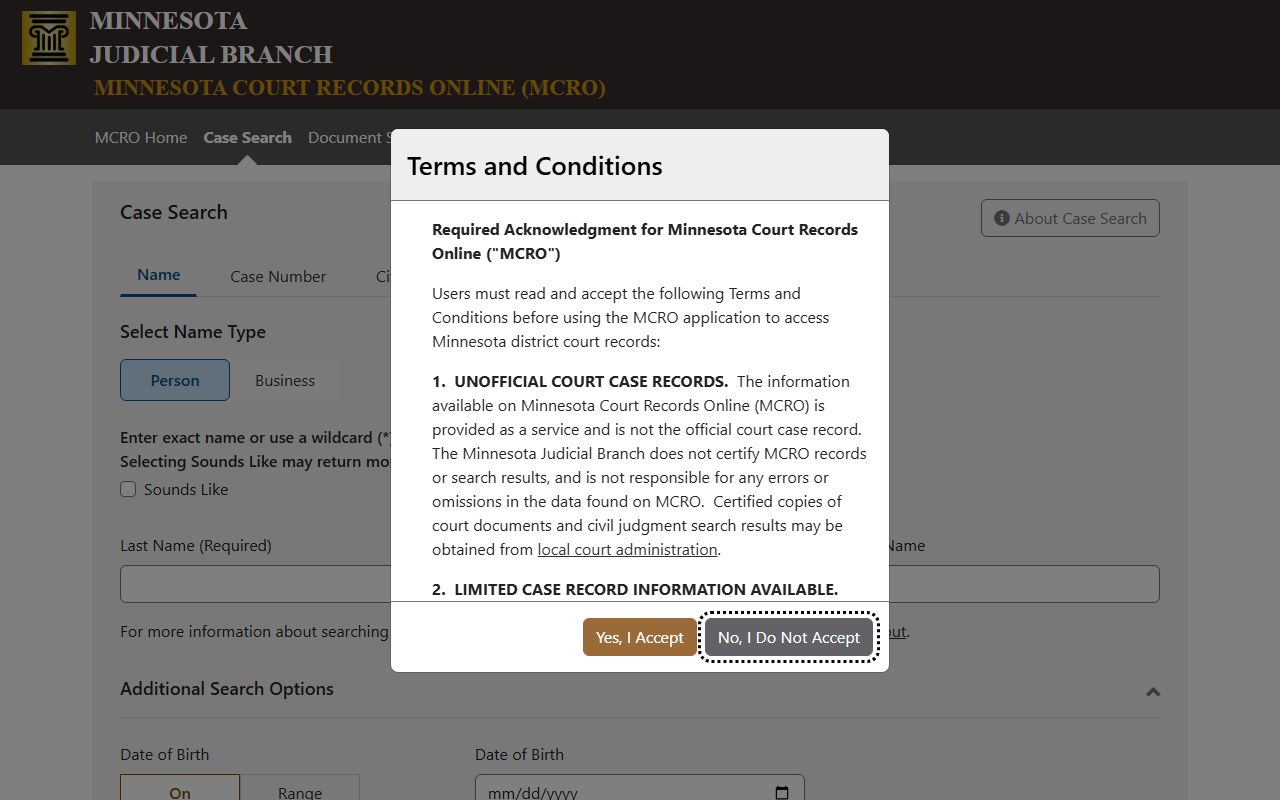
The screenshot subject matters because the search method changes the result. A name may work for older or convicted criminal cases, while a fresh Lyon County arrest often needs a case number, citation number, attorney search, calendar review, or help from court administration.
MCRO Search Fields for Post-Arrest Court Records
For Lyon County court records after a jail arrest, the best MCRO field is usually the most specific identifier available. A jail roster entry may provide useful facts, but it does not always provide the court case number. If the person was recently booked, a name-only search can miss the case because of the pending-criminal restriction.
| MCRO Search Path | Best Use After Arrest | Limit to Remember |
|---|---|---|
| Case Number | Best path for pending criminal cases when paperwork or court notice supplies the number. | Not available from every roster entry. |
| Citation Number | Useful for traffic and citation-based criminal matters. | Works only if the citation number is known and filed. |
| Person Name | Useful where remote access permits name search, especially after conviction. | Pending criminal cases cannot be searched by defendant name until conviction. |
| Attorney Name or Bar Number | Fallback when a defense attorney or prosecutor entry helps locate a pending matter. | Requires knowing the attorney information. |
| Document Search | Finds public documents available online, such as complaints or orders. | Document search uses the case number. |
| Hearing Search | Checks public hearing information by person, business, case number, judicial officer, or attorney. | Confidential and remotely restricted cases may not appear. |
Lyon County District Court and Calendar Context
Lyon County District Court handles criminal, traffic, juvenile, civil, family, and probate cases filed in Lyon County. It is part of Minnesota's Fifth Judicial District. The local court page is also the proper context for courthouse-level questions, calendars, court administration, certified records, and case-specific hearing information.
The court calendar is useful but incomplete by design. The official calendar notes that scheduled courtroom hearings may be listed, but confidential cases, matters not remotely accessible under Rule 8, and work handled outside the posted calendar may be absent. The absence of a name from the calendar does not prove a hearing was cancelled and does not prove that no case exists.
The Lyon County District Court page is the local court source for the county courthouse context.
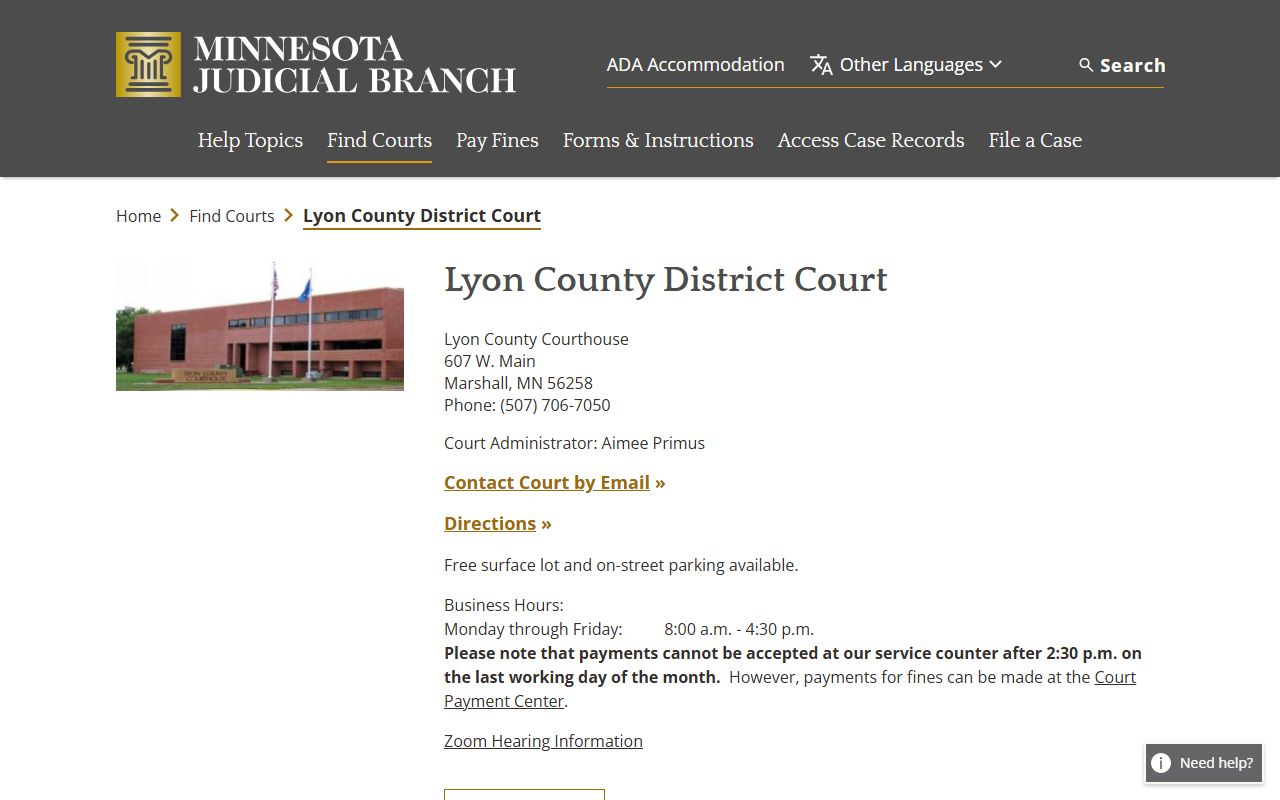
Use the court page together with MCRO. MCRO supplies many online records, while local court administration remains the source for certified copies and for records that are public at a courthouse terminal but not remotely available.
How Charges Get Filed After an Arrest: Complaint, Information, and Indictment
Booking charges are not always the charges that remain in court. A law-enforcement agency may arrest a person, book the person into Lyon County Jail, and list an arrest or hold description on the roster. The prosecutor then decides what formal court charges to file. In many Minnesota criminal cases, the complaint is the document that starts the court case and explains the alleged offense, statute, probable cause, and charge level.
| Charging Document | Who Drives It | What It Does | Why It Matters |
|---|---|---|---|
| Complaint | Prosecutor, often based on law-enforcement reports. | Starts many Minnesota criminal cases and lists the filed charges. | Usually the key document for understanding court records after a jail arrest. |
| Information | Prosecutor. | Charges an offense through a prosecutor-filed document where procedure allows. | May appear in felony or procedural contexts depending on the case. |
| Indictment | Grand jury. | Charges serious matters through grand-jury action. | Less common, but important for serious felony proceedings. |
The Lyon County Attorney can also amend charges after filing. A roster entry might say one thing on booking day, while the complaint, amended complaint, plea petition, or sentencing order shows a different charge level or final count.
Charge Status in Court Records After an Arrest
Charge status language explains where a court count stands. The inspected Lyon County roster showed statuses such as Bail Set, Hold Placed, Sentenced, Released Own PR, Time Served, and Chg Dismissed, but roster status is not a complete court docket. MCRO and the court record show whether the filed charge is pending, amended, dismissed, resolved by plea, resolved by verdict, or sentenced.
| Status | What It Usually Means | Lookup Note |
|---|---|---|
| Pending | The court case or charge remains open and has not reached final disposition. | Name search may be restricted on MCRO until conviction. |
| Amended or Reduced | The prosecutor changed the filed count, statute, severity level, or charge description. | Compare the original complaint with later docket entries or amended documents. |
| Dismissed | A count or case was ended by court order or prosecutor action without a conviction on that count. | The arrest or booking may still have existed even if the charge was dismissed. |
| Plea or Conviction | The case resolved through a guilty plea, verdict, or other conviction event. | After conviction, MCRO name-search availability changes for criminal cases. |
| Sentenced or Time Served | The court imposed sentence or jail time satisfied the sentence. | For prison commitments, later custody lookup moves to the Minnesota DOC locator. |
Bond and Release After an Arrest
Lyon County publishes practical bail instructions. During business hours, bail may be posted at the Court Administrator's office on the third floor of the courthouse from 8:00 a.m. to 4:30 p.m. After hours, bail may be posted at the front lobby of the jail by asking for the on-duty sergeant or correctional officer so staff can begin paperwork. The county states that personal checks are not accepted for bail.
Bond in the court record is different from custody status on the roster, but the two should be read together. A person may have a bail condition on one charge and still remain in custody because of a hold from another county, a probation or parole hold, a DOC hold, a warrant, or another agency detainer. Court-filed bail amounts, bond modifications, and release-condition orders belong in the court record.
| Bond or Hold Term | How It Works in Lyon County Context |
|---|---|
| Bail Set | A bail condition exists, though the roster capture did not always show a dollar amount. |
| Surety Bond | A licensed bondsman may be used only if the court order allows that option. |
| Released Own PR | Release on personal recognizance, meaning a promise to appear rather than a cash deposit. |
| Hold Placed | A hold or detainer may block release until the other authority or case issue is resolved. |
| No Personal Checks | Lyon County jail policy specifically says personal checks are not accepted for bail. |
Warrants That Lead to an Arrest and Court Records
The Lyon County Sheriff's official links page includes a Top Ten Most Wanted link, but the captured official county pages did not show a complete countywide active warrant search form. A most-wanted page is a curated public-safety list, not a full warrant database. It should not be used to conclude that a person does or does not have an active warrant.
Minnesota Statutes section 13.82, subdivision 19 treats data in arrest warrant indices as confidential until the defendant has been taken into custody, served with the warrant, or appears before the court, unless law enforcement decides a public purpose supports release. That rule explains why warrant data can be limited online. Once someone is arrested on a warrant and booked into Lyon County Jail, the roster may show a hold or charge status while the court case or agency records carry the warrant detail.
Charges vs. Convictions in Lyon County Court Records
An arrest and a filed charge are not the same as a conviction. A charge is an accusation filed into court. A conviction requires a guilty plea, verdict, or other qualifying conviction event. This distinction matters for employment, housing, licensing, reputation, and even search mechanics because MCRO's pending criminal name-search restriction changes after conviction.
| Charge | Conviction | |
|---|---|---|
| Stage | An accusation after arrest, citation, complaint, or other charging action. | A final result after plea, verdict, or qualifying disposition. |
| Proof Level | Based on filing standards such as probable cause. | Requires proof beyond a reasonable doubt or a valid guilty plea. |
| Can Change | May be amended, reduced, added, or dismissed. | May later be appealed, vacated, sealed, expunged, or otherwise affected by court order. |
| Where to Check | Complaint, register of actions, roster context, and hearing entries. | Disposition, sentencing order, register of actions, and certified court record. |
Sealed vs. Expunged Arrest and Court Records
Minnesota public access rules do not make every arrest, jail, or court detail available online. Juvenile matters, protected identities, medical or mental-health information, victim and witness details, safety-sensitive detention information, active investigative data, and remotely restricted court records can be withheld or redacted. Dismissal or acquittal also does not automatically erase every record in every system.
| Sealed | Expunged | |
|---|---|---|
| Basic Effect | Public access is restricted by court rule, statute, or order. | Access is restricted through an expungement order or statutory expungement process. |
| Record Location | The record may still exist at the court or agency. | The record may still exist but is treated under the limits of the expungement order. |
| Who May See It | Access may remain for courts, law enforcement, or authorized users. | Access depends on Minnesota law, the order, and the requesting agency. |
| Practical Path | Ask the court or originating agency about the specific case and access rule. | Use the court process and provide the order to agencies that still display records. |
Public Access Laws for Court Records After a Jail Arrest
Minnesota Statutes section 13.82 governs law-enforcement data, including arrest data, public-benefit releases, protected identities, and warrant-index confidentiality. Minnesota Statutes section 13.85 governs corrections and detention data and classifies many individual detention details as private or confidential unless public by statute, summary data, arrest data, or reflected in court records. Minnesota Statutes section 641.05 requires every sheriff to keep a permanent record of persons committed to jail.
Judicial Branch public-access rules add a separate layer. MCRO operates under remote-access limits, and Rule 8 can keep some otherwise public court records off the internet. For that reason, a Lyon County case can be public at the courthouse but not searchable in the same way from home.
FCRA notice: Lyon County Inmate Population is not a consumer reporting agency. Do not use jail, court, or custody lookup information for credit, employment, tenant screening, insurance, or another FCRA-covered purpose.